
If, on the day of the notarial transfer, defects in the sold property come to light, the parties sometimes choose to place part of the purchase price in escrow with the notary. What should you pay attention to in that case?
In notarial practice, it does occur that the transfer of a property is postponed due to defects in the sold property. However, postponing the transfer is generally undesirable. In such cases, the parties sometimes decide to proceed with the transfer, while placing part of the purchase price in escrow with the notary. Recently, the Notarial Disputes Committee issued a decision in a case concerning an escrow agreement.
What is an escrow agreement?
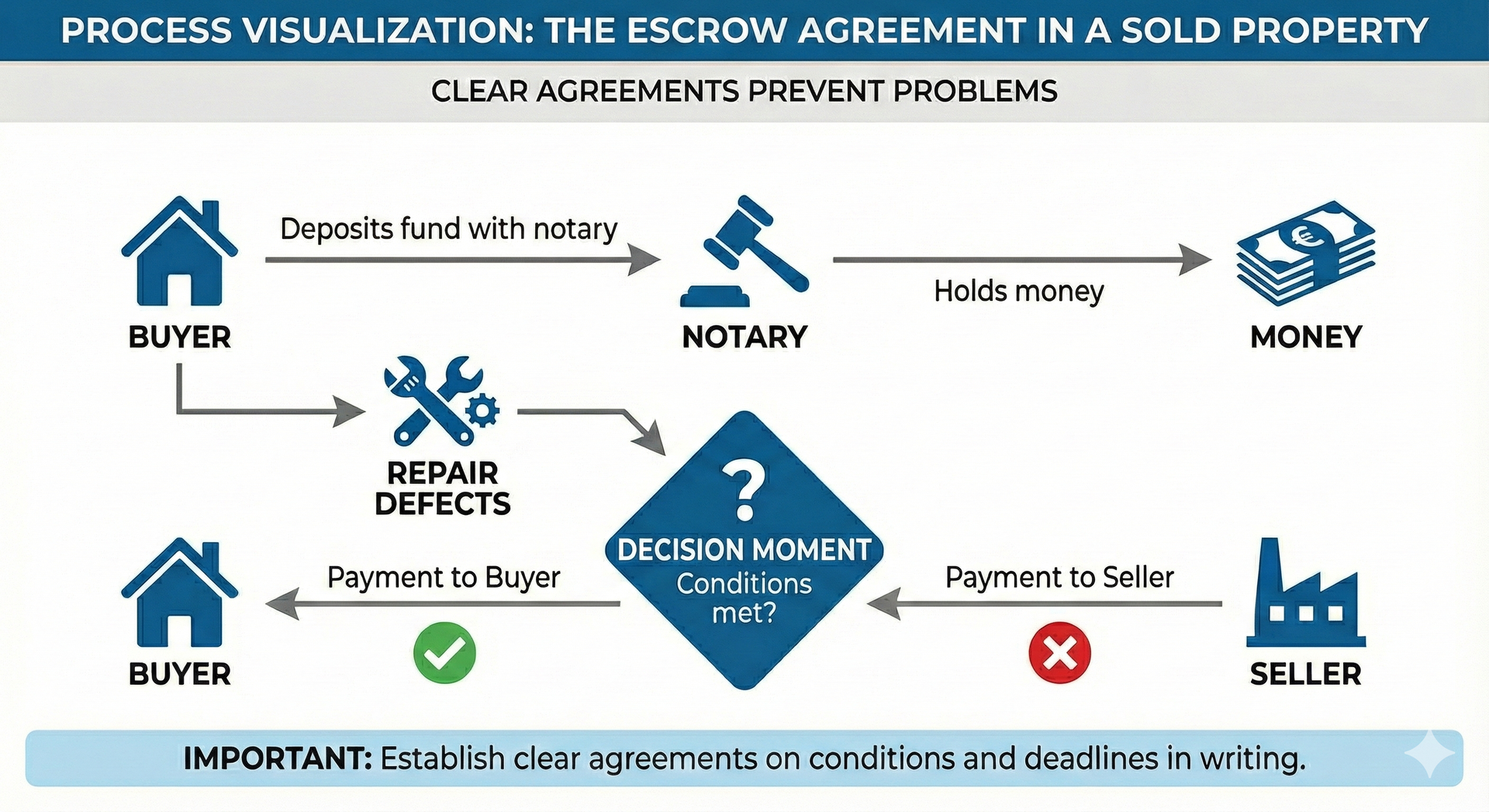
In a real estate transaction, an escrow agreement can be regarded as a three-party agreement. The notary undertakes obligations towards both the buyer and the seller to hold the escrow amount until, based on the escrow agreement, the notary is required to release the funds.
Practical example from the Notarial Disputes Committee
In the decision of the Notarial Disputes Committee (Reference number: 197813/203748), the following situation arose:. Sandra purchased a property from a property developer. Due to defects in the property, an amount was placed in escrow with the notary. Sandra has since requested payment of the escrow amount, but the notary has refused to release the funds.
In July 2020, Sandra acquired ownership of the property. Due to defects in the property, Sandra deposited an amount of €15,000 with the notary. An amount of €7,500 has already been paid to the property developer. The remaining €7,500 is still held in escrow by the notary. The notary drafted an escrow agreement. This agreement provides, among other things, that the notary must release the escrow amount to Sandra if, after two years, the parties have still not given matching instructions to the notary and no legal proceedings have been initiated. According to Sandra, this situation applies. More than two years have passed and not all defects have been resolved. Sandra therefore requested the notary to release the escrow amount, but the notary refused.
The notary takes the position that he cannot and may not determine substantively which party is wholly or partially in the right. This role and authority belong to the civil court. The notary did not honor Sandra’s request for payment of the escrow solely on the basis that two years had elapsed, given the intent of the provision in the escrow agreement, the circumstances of the case, the positions taken by the parties, and his statutory duties as a notary.
Decision of the Notarial Disputes Committee
The escrow agreement provides, among other things:
“If, two (2) years from today, no matching instructions have been given and no legal proceedings have been initiated, the notary shall release the escrow amount of full amount (in case: €15,000) to the buyer.”
Given that more than two years had passed and that there were neither matching instructions from Sandra and the property developer nor any legal proceedings, the committee considers Sandra’s claim for payment of the escrow amount to be justified. The committee rules that the notary must perform the escrow agreement, which means that the amount must be paid to Sandra. Sandra did not request interest on the amount, although this would have been possible.
Visual summary of the process
Conclusion
In this case, the escrow amount should have been released. However, it is important that the arrangements in an escrow agreement are clear to all parties. It must be clear to everyone under which conditions the notary is allowed to release the escrow funds.